

-
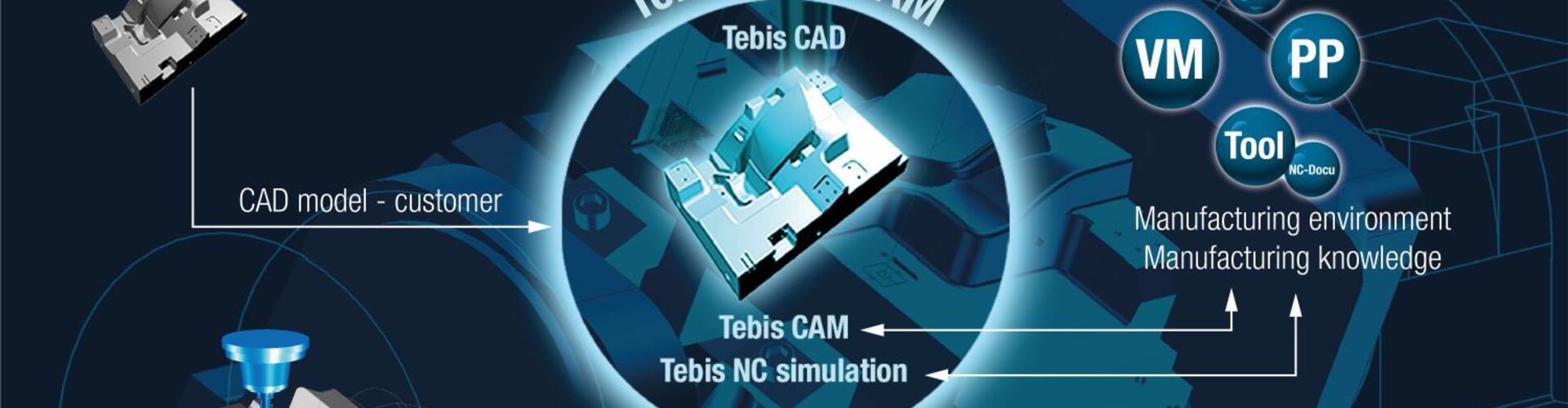
Intelligent Manufacturing, with Best Practice Built into Libraries
Tebis is well known as a premium CAD/CAM and MES software company who offers advanced solutions for model, pattern, die and mould making as well as mechanical component manufacturing. Tebis also helps customers to optimise CNC machining processes and to automate CAM work with Intelligent Manufacturing technologies.
Tebis Intelligent Manufacturing software and associated services help customers to increase productivity and profitability.
The best CNC machining practices of a company can be built into Tebis library database which can then be shared and reused for daily operations. This will help to optimise uses of machine capacities and cutting tools as well as to optimise machining processes and machining parameters. Tebis works together with customers to define goals and to achieve them, with experiences of thousands of projects done worldwide.
Tebis’ unique knowledge-based machining technology supports database with 6 libraries:
1. Virtual Machine Library2. Clamping Devices Library
3. Cutting Tools Library
4. Geometry Feature Library and Feature-based Machining
5. Machines Cycles library
6. Machining Process Library
Virtual Machine Library
One of the key offerings of Tebis CAD/CAM is Digital Twin for optimised CNC machining. With the unique manufacturing database structure as the core of Tebis CAD/CAM system, all key elements of customers’ manufacturing environments can be built into Tebis libraries as one to one Digital Twins same as the physical objects on the shopfloor, which can then be used to optimise CNC machining. This is especially significant that all toolpaths and machining parameters can be optimised for individual machine tools on the shopfloor with machine-oriented CAM programming, in addition to optimisations for cutting tool/toolholder assemblies, workpiece materials, clamping devices, and machining processes, etc.
Clamping Devices Library
Tebis clamping device library represents all common devices for fixing parts in the machining process. From the screwless vise to clamps and chucks, all common clamping devices can now be easily managed in a library and quickly used for realistic simulation and collision checking. In the CAD/CAM model, the precise clamping position can be exactly aligned, zero point and conventional clamping systems represented, and all assembly possibilities checked. Tebis supports virtual clamping and validation with Clamping Device library, which increases productivity and profitability by saving time on job setup and avoiding costly wrong clamping and fixturing at the shopfloor.
Cutting Tools Library
Tebis cutting tool library not only stores cutting tool geometry shape information, but also stores advanced machining parameters grouped for different materials, different tools and toolholders, different machine tools as well as different machining processes. Tebis cutting tool library stores comprehensive machining parameter types such as corner feed rates, stepdown feed rates, machining depth, machining width and coolant options in addition to conventional machining parameters.
Tebis cutting tool library is capable of storing exact geometries of cutting tools, tool holders and intermediate tool holders and validate the assembly. This ensures these elements used by the CAM users are correct and available on the shop floor.
With the cloud-based environment, Tebis has the master tool library sitting on the cloud central server which is managed by the administrator to ensure consistent uses among all users even across different work shifts and sites.
Geometry Feature Library and Feature-based Machining
Tebis Geometry Feature library recognises geometry data within CAD models. Once Tebis software recognises the geometry data and assigns some basic attributes, then, Tebis can start to add predefined machining operations to machine the geometries in the CAM programming process. This creates an environment where machining operations and parameters for machining the features can be optimised, standardised, predefined and are consistent across the company’s entire working process to improve CAM programming efficiency and quality.
With Geometry Feature library, Tebis automatically detects and assigns features to the geometries and automatically group features for machining. In addition to working with ruled geometries, Tebis software also recognises free-form geometries and does feature-based NC programming. Features are not limited to the usual 2.5D type features such as holes and a slots, Tebis software is also capable of dealing with 2D open features and free-form shapes.
Machines Cycles library
Tebis NCSets are sets of predefined machining operations for individual geometry features. Once the NCSets are associated with geometry features, they can be used to machine entire groups of geometries with a single programming operation.
Tebis NCSets can be defined and optimised, then, shared among CAM engineers as database library. This means that new recruits will only need one or two weeks training. This also means greatly reducing the difficulty and workload of CAM work as well as reducing the costs of CAM work by reducing the number of CAM personnel and also wage level for junior engineers while senior engineers can create more value by optimising CNC machining processes.
Machining Process Library
CNC machining processes with series of toolpaths can be created, optimised and stored within Tebis library as templates. The predefined machining processes mean that every time a new part is programmed, the surface quality and part accuracy is the same every time. With this level of consistent programming, it is very easy to control quality and also estimate how long a part will take to manufacture.
The automated programming also allows job knowledge to be retained within the company. If the company loses a key member of staff, the standards and strategies already developed within the company are retained with Tebis libraries. This also means that if the company employs a new CAM engineer, the new recruit can produce parts to the company’s own existing standards rather than learning from the scratch. This comes with the added benefit that the learning curve for a new user can be much shorter than having to learn the entire software and machining processes.
Contact

