


-
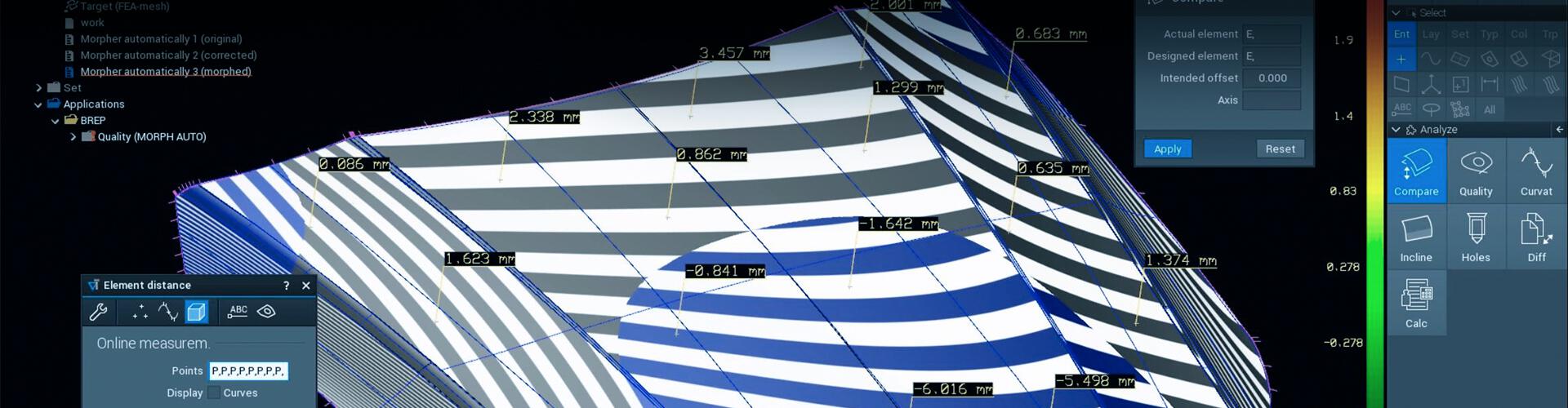
Compensating springback in CAD die surfaces
Achieve enormous time savings in die tryout with global surface morphing
The elastic properties of the sheet-metal cause springback after the forming of sheet metal parts. This springback is compensated in the sheet-metal die, so that the part is initially formed to an "incorrect" geometry and then springs back to yield the desired geometry. Manually grinding springback in the die is extremely time-consuming in the tryout presses Process reliability is also affected.
Tebis therefore uses global morphing rules with which individual surfaces can be deformed completely automatically based on FEM analyses, measurements, digitized data or experience – and feedback is compensated, greatly reducing the number of correction loops. The qualitative surface properties such as segmentation, polynomial degree, and transitions are optimally adjusted to the morphing rule in this CAD-based morphing. Analysis functions indicate adherence to the morphing rule and to the quality of the formed surfaces.
Substantial time savingsLess grinding work and fewer corrections cycles in tryoutHigh process reliabilityA learning system based on prediction, morphing and subsequent analysisHigh CAD data qualityThe quality of the morphed surfaces meets the requirements of active surface and die designMultiple morphing rules
Tebis offers several options for defining the morphing rule. All morphing rules can be combined together.
From simulation systems
FEM systems specializing in the simulation of sheet metal deformation simulate springback and provide compensation rules, such as with two triangular meshes. Tebis uses these and automatically morphs the affected area of the active surface of the die.
From experience
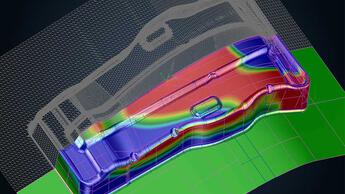
If the expert knows how the sheet metal springs back and how it must be deformed, the morphing rule is created in Tebis with a substitute surface pair (visible in the background) that represents the desired morphing. Rules can also be specified with vectors and rotation.
From measurements
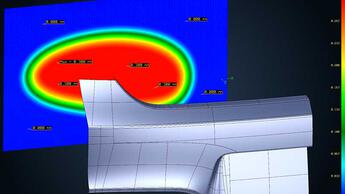
Tebis takes the measuring points determined on the test part with springback, calculates the distances from the desired part, and automatically compensates the CAD surfaces in the die.
From digitized data
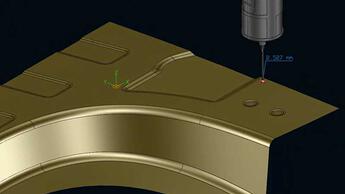
The comparison between the scanned sheet-metal part and the CAD surfaces of the die indicates where springback is occurring. The meshes from the scanning process are used to define the morphing rule. Also: Scanned sheet-metal parts can be quickly and easily reverse engineered to surfaces in Tebis (see Tebis reverse engineering).
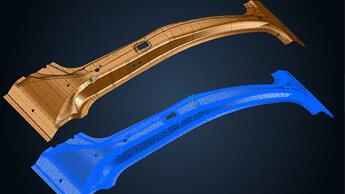
Morphing of outer skin surfaces based on results from forming simulations
The predictions regarding springback are imported in Tebis through interfaces to simulation systems, and the CAD surfaces are automatically morphed. The better the original surfaces are, the better the morphed resulting surfaces will be. Tebis offers an extensive function package for the analysis and optimization of CAD surfaces before and after deformation.
Morphing sheet-metal parts based on measuring points
Tebis takes the measuring points determined on the test part with springback, calculates the distances from the desired specified part, and automatically compensates the entire sheet-metal part.

Our new department structure as well as the Tebis solution for morphing and the Tebis analysis and optimization functions enabled us to get correction grinding under control. We scored in all areas: Parts got to the machine faster, CAD data and NC programs could be updated faster, and surface quality was even better.
Volkswagen AG
What used to take a week, we can now accomplish in a single day using Tebis Morphing, and the need for manual reworking has gone down.
Merima Präzisions-Werkzeugbau GmbH, Germany


