


-

Process safety in single-part manufacturing with an end-to-end CAM strategy
Company
BW-CNC GmbH
Location
Lienz, Austria
Focus
5-axis single-part manufacturing, prototyping, and demanding contract manufacturing
Benefits:
- Comprehensive CAM strategy with Tebis 4.1
- Reliable collision checks
- A smart approach to multiple setups
- Automatic feature recognition
- Tool database
- Simulation
- SmartOps
- Digital process safety
Sector
Die manufacturing
Machinery and equipment
Aerospace
Published
2026

Interviewee: Michael Bader, Managing Director of BW-CNC
For us, choosing Tebis wasn’t just an investment in CAD/CAM technology—we’ve also found a reliable partner who supports us in achieving our goals.
Michael Bader, Managing DirectorBW-CNC GmbHStarting from scratch, this company quickly became in-demand as a capable problem solver: BW-CNC in Lienz, East Tyrol (Austria), demonstrates how top performance can be achieved even in the face of time pressure, thanks to experience, flexibility, and state-of-the-art 5-axis technology. This young company has quickly made a name for itself with its clear focus on demanding individual parts and prototypes, as well as digitalization of processes. For its CAM technology, it relies on Tebis—and with good reason.
BW-CNC GmbH is located in Lienz, East Tyrol (Austria) and manufactures a wide range of workpieces in a variety of sizes and shapes. As a contract manufacturer, it works with everything from 10 × 10 mm workpieces for medical engineering to 1500 × 1500 mm parts for hydroelectric power plant construction and the aerospace industry. BW-CNC is a young company with motivated employees.
“A few years ago, the long-planned takeover of the company that I managed—where some of us had worked for decades—fell through at the last minute. So in late 2023, we founded BW-CNC as a dedicated contract manufacturing company,” explains Michael Bader, Managing Director of BW-CNC.We had to make some fast decisions, and we were basically starting over from scratch. Our company is still very young, but our customers can rely on our employees’ many years of experience. And we put 100% of our technical know-how to work on our 5-axis CNC machining centers.
The human element is key
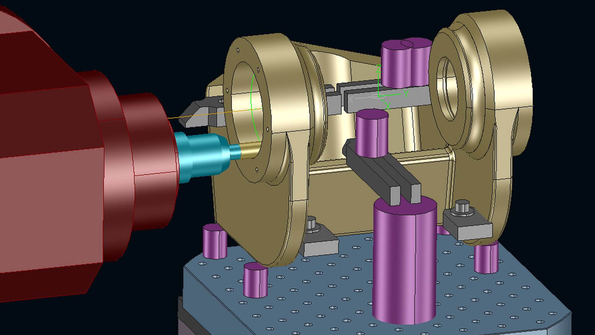 To make sure the simulation uses real-world data, the machinists had their machines measured and entered information on all the relevant components, from tools to clamping devices, into databases. Blanks are also measured on the machine. – Photo: BW-CNC
Quite a few of their customers came with them from their old company. These customers trust the people who make up BW-CNC and value the expertise, flexibility, and creativity of its committed team. And because it can meet even seemingly impossible challenges on very short deadlines, this company has quickly earned a reputation as a flexible problem-solver.
“We manufacture parts for all industries out of almost any machinable materials—from plastics, to various aluminum alloys, different cast materials, steels, and stainless steels, to tough materials like Inconel,” says Bader, describing the company’s range of machining capabilities.Our customers’ favorite lot size is one, often together with a mirrored version. We also frequently do prototypes and pilot series, typically up to 50 units.
“Impossible” parts are our bread and butter
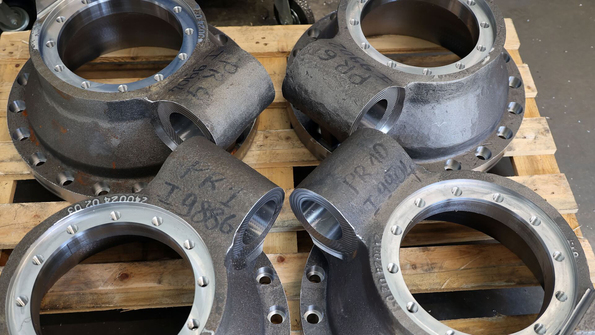 BW-CNC can machine a wide variety of materials. They often work with blanks made from a wide variety of cast materials, as in this example, but they can machine anything from plastics to aluminum alloys, steels, and stainless steels, as well as titanium and Inconel. – Photo: Pergler Media
And customers often ask Bader for precisely such “impossible” parts:
We tackle workpieces like these and take the time to assess their feasibility and cost-effectiveness,
explains the machining expert. “These jobs push our machines and tools to their limits—and sometimes even beyond. Furthermore, our customers often are working on tight deadlines, so our throughput times—from when the order is placed to when we deliver—are normally between two and three weeks.”
BW-CNC’s eight employees have a small but technologically sophisticated and highly capable range of machinery at their disposal: an Emco MMV 3200 5-axis machining center with a rotary table for 5-axis simultaneous machining, a Mazak Integrex i200H S turning/milling center with a counter spindle and part unloading station, and a Mazak CV5-500 precision machining center.Cheap ≠ cost-effective
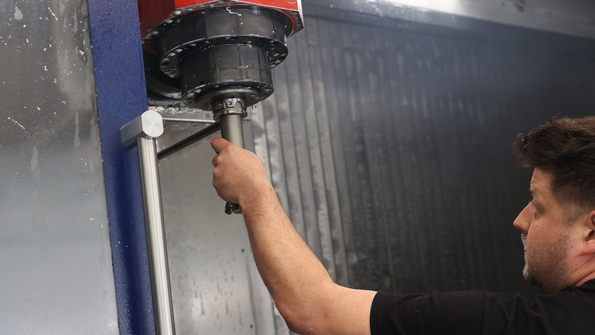 The eight employees have access to a small but technologically sophisticated and highly capable range of machinery. – Photo: Pergler Media
As its CAM system, this contract manufacturing company uses the latest version of Tebis 4.1. But they didn’t always do so: “We were already familiar with Tebis from our old company, where we had manufactured a huge number of large molds for the automotive and aerospace industries, and it was our clear favorite among the various CAM systems we used. In other words, we were well aware of Tebis’s capabilities, and it was at the top of our wish list,” explains Bader. “However, Tebis isn’t exactly the cheapest CAM system, and in a new company, money can be tight. So we decided to go with another popular CAM software package, which the vendor claimed could meet our needs just as well. That turned out to be far from true—this software couldn’t even mirror workpieces without problems, which is an absolutely essential capability for us.”
The vendor was unable to help and, in general, they were not very cooperative and refused to cancel our contract.The decision to go with a cheap system almost turned into a fatal misstep for our young company and could have ruined us just when we were getting started,
explains Bader. “The two dongles for that CAM software are still lying unused in my drawer.”
Flexibility on the financial side too
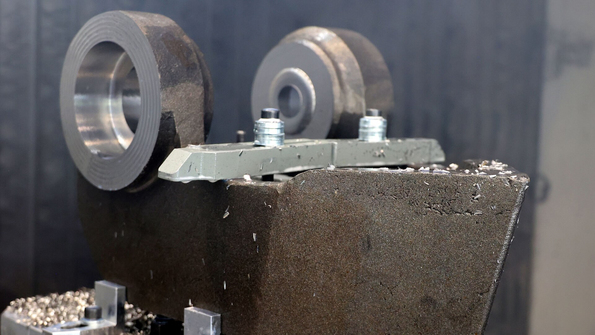 No program is sent to the machine until it has first been checked for collisions. This helps avoid costly mistakes and meet the tight deadlines that customers demand. – Photo: Pergler Media
Bader knew he couldn’t afford to make another mistake, so he turned to Tebis. “They were immediately receptive to our needs and very understanding about our situation,” explains the company’s Managing Director. “For example, the financial arrangements we settled on proved less painful than we’d feared.”
In terms of software, Bader went all out and now makes use of many more Tebis functions than he used to at his old company. “In established companies, structures and processes often get set in stone over the course of years, making change difficult,” he explains.We were able to start from scratch and set up our workflows and processes exactly as we wanted. Together with the Tebis experts, that’s exactly what we did.
Easy correction options
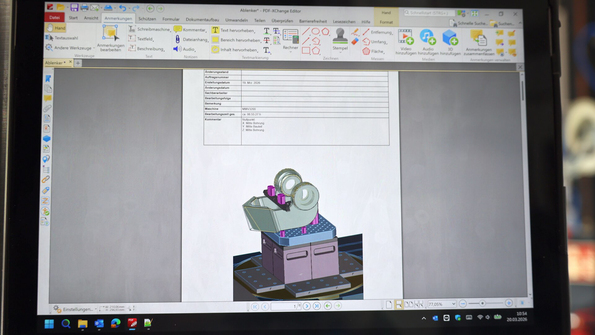 Machine operators can access all the relevant setup information via tablet. The attached PDF also provides a graphical visualization of the exact setup configuration. With these features, misunderstandings are easy to avoid. – Photo: Pergler Media
Thanks to sophisticated interfaces, Tebis can import CAD data quickly and reliably from a wide variety of customer systems. Errors are detected promptly and usually can be corrected easily, but not always: “For example, if whoever reverse engineered the surfaces knows nothing about programming, some strange error patterns can arise,” explains Bader.
In this case, instead of making corrections within the program, it usually makes more sense to reverse engineer the surface again. Tools, machining strategies, general processes—they’ve all been rethought and implemented accordingly.
“When we purchased our Emco machining center, we opted for the rotary table. That not only significantly expands our machining capabilities but also achieves a noticeable reduction in setup times, since we can now simply rotate workpieces into new positions and continue machining without having to change the setup. We also frequently work with multiple setups—and Tebis offers intelligent features to support this.”
No time for manual steps
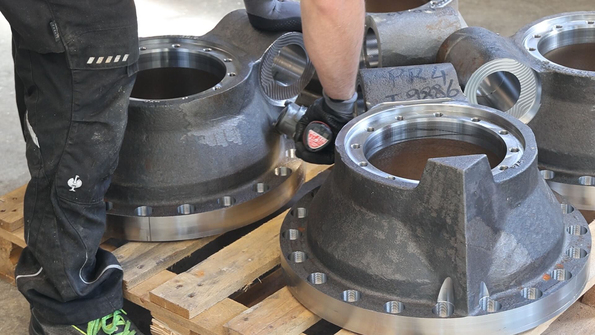 The aim is to avoid manual steps as much as possible. The workpieces should come off the machine ready to be cleaned and packaged. – Photo: Pergler Media
As an eight-person company, BW-CNC is usually at full capacity. “We all do everything here,” admits Bader. “Everyone pitches in where they’re needed.” However, BW-CNC could stand to add a few more skilled workers, but, like everywhere in Austria, the Lienz Valley region is experiencing a shortage.
“That leaves no time for manual steps—which no one really enjoys anyway,” explains Bader.For example, whenever possible, deburring needs to be performed entirely on the machine—so the CAM system needs to support that. Our goal is to have the machines deliver finished parts that at most require cleaning and packaging. And that’s exactly how we’ve set things up.
What comes out is only as good as the data that goes in
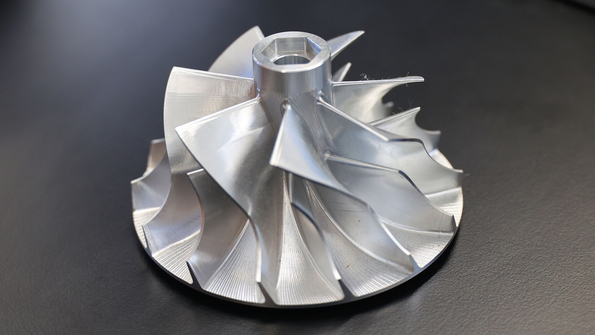 Our customers come from a wide variety of industries, ranging from power plants, to aerospace and medical engineering, and the workpieces range in size from 10 × 10 to 1,500 × 1,500 mm. – Photo: Pergler Media
Most importantly, the machinists need confidence that the processes will run exactly as planned. That requires a bit of preparation.
With Tebis’s support, we’ve built up our tool database. It stores precise information on all the standard tools, along with the associated cutting parameters for the various materials we machine. The holders are also numbered, measured, and laser-marked,
explains Bader. “This covers about 80% of our tools. The rest are special tools—and since we store precise information on the individual components, we can quickly and reliably incorporate these data and values into the programming as well.”
To ensure 100% collision checking of the programs, the machinists have also measured their clamping devices and entered the information into a database. Tebis specialists have scanned the machines meticulously. Setup is performed exactly according to the plan, as displayed via a tablet on the machine, and the workpieces are probed on the machine in a measurement cycle.The CAM system supports users in a variety of ways
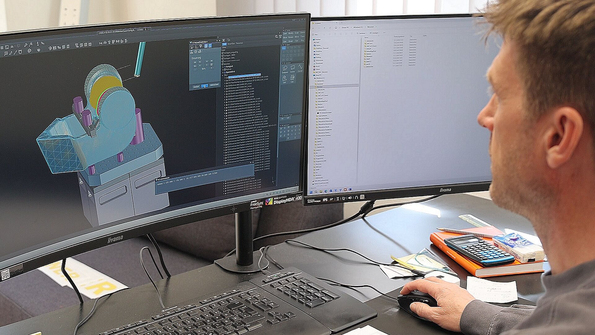 Tebis supports professionals with well thought-out functions. For example, BW-CNC makes extensive use of automatic feature recognition. Simulation based on real-world data ensures safe collision detection—only simulated programs are sent to the machine. – Photo: Pergler Media
“Skilled workers’ time is simply too valuable for them to spend a long time running machines in and then just watching the process,” explains Bader.
The Tebis CAM system supports us in a variety of ways. Ultimately, it ensures that our machine operators work with real-world data and that the programs can be executed exactly. It also enables safe operation of multiple machines.
Besides safety, another benefit arises when programmers can examine a cast part before machining and enter the actual stock allowances into the program. If they allow for too much “air cutting,” that wastes time and money; with too little, problems can arise and waste even more.
Unattended operations require stable and reproducible processes
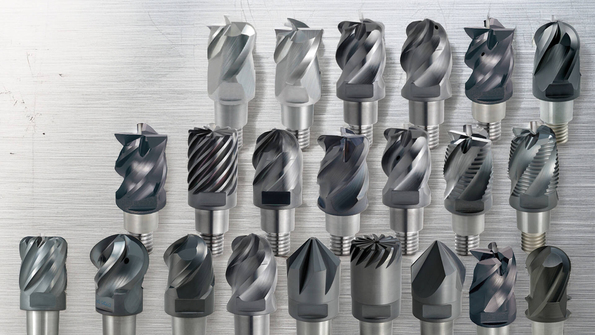 The machinists rely on Mitsubishi Materials tools. With this Japanese manufacturer, they can have nearly complete confidence in the geometric data, as well as other important properties like predicted service life. – Photo: Pergler Media
When large numbers of processes are automated and run unattended, machinists need to be able to rely on their technology. “For example, we usually rely on Mitsubishi Materials tools,” says Bader.
We know we can have nearly complete confidence in the geometric data, as well as other important properties like predicted service life. The quality and the price/performance ratio are good.
The machining results are also perfect. “Even on challenging surfaces, there are no visible marks from where the tool penetrates the material,” Bader reports. “Mitsubishi Materials Tools Europe is also an excellent partner for critical operations. For example, we had to drill a hole 1 mm in diameter and 100 mm deep in a hard-to-machine material. With a carbide drill bit from Mitsubishi Materials, we can do so reliably. The customer promptly gave us a new challenge: 1.5 mm in diameter and 250 mm deep. And as a tool manufacturer, Mitsubishi Materials will provide support and advice for this challenge too.”
High precision for cost-effective machining
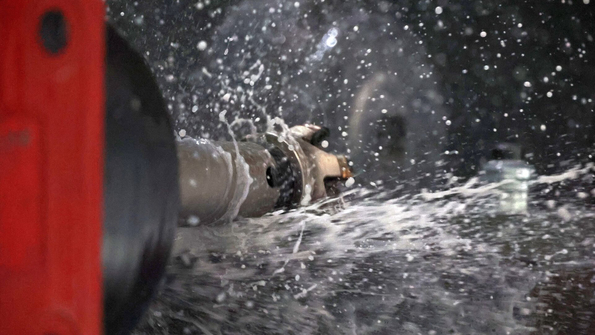 When large numbers of processes are automated and run unattended, machinists need to be able to rely on their technology. That’s not only true of the machines but also of the tools and CAM system. – Photo: Pergler Media
The machinists like to use Mitsubishi Materials’ iMX End Mill Series. This system combines maximum precision with flexible, cost-effective machining for steel, stainless steel, aluminum, titanium, and Inconel, even with long overhangs. A coating on the interchangeable cutting heads increases wear resistance by reducing cutting resistance. “New tools are recorded in our CAM system’s databases as soon as we get them,” explains Bader. “One programmer spends about four to five hours a week on this task.”
Tebis supports professionals with well thought-out functions in many other respects too. For example, BW-CNC makes extensive use of Tebis’s automatic feature recognition. “Our CAM system can program a plate with a large number of holes almost entirely automatically—and that’s exactly what we need,” emphasizes Bader.That allows our programmers to focus on what really matters and spend their valuable time optimizing the programs.
Training is very helpful even for experienced users
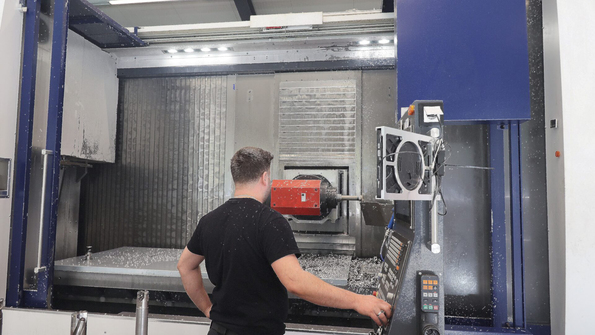 The Lienz Valley region is not immune to the shortage of skilled labor. Therefore, the aim is for machining operations to mostly run unattended. Tebis provides the foundation for reliable, consistent manufacturing. – Photo: Pergler Media
The programmers are learning Tebis’s new functions and capabilities as they go; at the moment, they are in the process of implementing SmartOps.
The training Tebis offers is very helpful, and we make extensive use of it,
says Bader. “Even as an experienced programmer, you’ll discover a lot of new things and learn many faster and better ways to get to the best possible program. And that’s incredibly helpful for making your company more competitive in the long term.”
Cooperation with the software company is very close in other areas too. “When we encounter a problem we can’t solve on our own, the experts at Tebis help us find a solution,” emphasizes Bader. “One example is efficiently programming and machining a series of workpieces that differ in, say, only one thread and are otherwise identical.” Getting a detail like this right can make such parts much easier to process, and the machinists are now working together with Tebis experts on this challenge.
A reliable partner that supports users’ goals
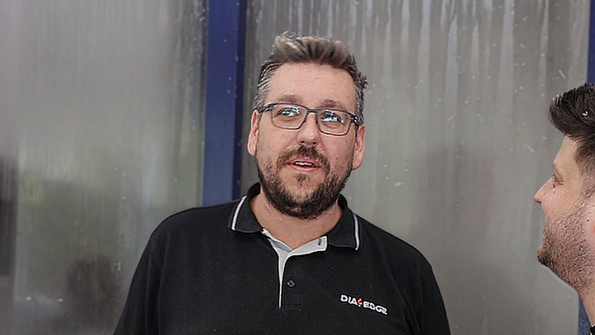 Michael Bader, Managing Director of BW-CNC: We’re sold on Tebis. This investment has given us so much more than just a CAD/CAM system— we’ve also found a reliable partner who supports us in achieving our goals. Tebis is not cheap, but it’s well worth the price!” – Photo: Pergler Media
They take our requests and suggestions seriously, even though we’re not a big company. In particular, the application engineers frequently become personally invested in solving such problems.
Oftentimes, the next release, or the one after that, contains the solution we need. And that’s how Tebis has earned our loyalty: This investment has given us so much more than just a CAD/CAM system—we’ve also found a reliable partner who supports us in achieving our goals.
Tebis is a top-quality provider and worth every penny!
Profile
BW-CNC GmbH
BW-CNC GmbH in Lienz (Austria) is a young, dynamic company specializing in contract manufacturing of a wide variety of parts in lot sizes ranging from 1 to 50. Founded on December 15, 2023, the company’s success is due to its motivated employees and focused approach, as well as its reliability and technical excellence. Equipped with high-performance machining tools, the team of eight experts specializes in innovative technologies and high-quality services for machining a wide variety of materials. Typical throughput times, from when an order is placed to when the parts are delivered, range from two to three weeksFocus
Tebis SmartOps
For the kind of single-part and small-series manufacturing that BW-CNC offers, fast, precise solutions are essential—both on the machine and in the CAD/CAM process. Tebis’s SmartOps Technology supports a high degree of automation for design and CAM programming. This ensures both maximum flexibility and maximum process safety. Wizards guide users through individual process steps, but they can still intervene and make changes as needed. Thanks to the parametric nature of SmartOps, the entire process is very easy to modify. For users, this means a noticeable workload reduction, less time pressure, and reliable, reproducible results at all times.Our philosophy
“If you buy cheap, you buy twice”
Michael Bader thinks the initial decision to invest in a “cheap” CAM system was the biggest mistake in his company’s short history. Although a well-known vendor provided the solution, they clearly had little interest in helping the machinists at BW-CNC meet their challenges. This vendor lacked a true customer focus and refused to cancel the contract, so Bader had to eat the costs. In contrast, an investment in the Tebis CAM package pays for itself, and users can always count on knowledgeable customer contacts. Whether they’re working with a sole proprietor or a big company, these contacts always take programmers’ and machinists’ concerns seriously and prioritize finding solutions to their problems. That’s because Tebis is a CAM provider that sees its users as partners and helps them become and remain more competitive in the long term.Richard Pergler


