

-
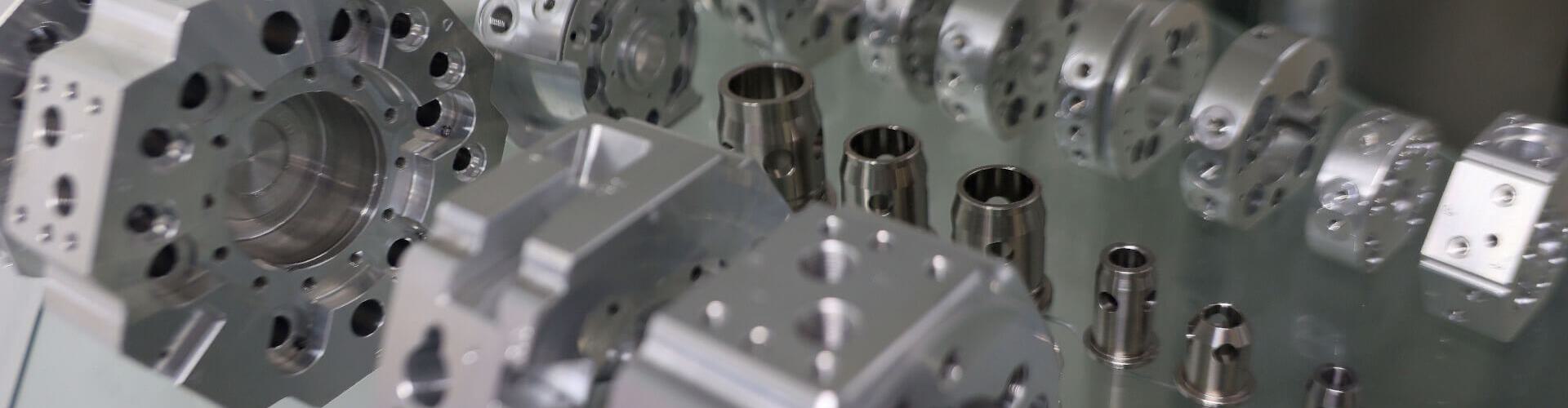
IPR has reduced programming time by one-third thanks to Tebis
For over 35 years, Eppingen-based IPR Intelligente Peripherien für Roboter GmbH has been designing, manufacturing and selling automation components for assembly and handling.
These experts in robot peripherals know they are in good hands when working on their 2.5D parts in Tebis because they can reduce programming time by one third thanks to the software’s intelligent features and automation.Company
IPR Intelligente Peripherien für Roboter GmbH
Location
Eppingen, Germany
Focus
Offering a range of standard and special grippers, robot transfer units, robot load limiters, axis compensation modules extending to tool changers for robots
Benefits:
- Automated programming of routine tasks using Tebis 4.1 features and templates
- Tebis modules for 5- and 3-axis milling ensure high precision and increase productivity
- Safe, reliable machining using a digital twin/virtual machine
Sector
Automotive
Production machining
Assembly automation
Supplier industry
Published
2026

Interviewee: Daniel Schiefer, Deputy Production Manager, CAM programmer and machinist
We feel like we are taken seriously as users. When we have challenges to tackle, the experts at Tebis are always very constructive and proactive. This high-end user-oriented support gives Tebis a unique advantage over other CAD/CAM providers.
Daniel Schiefer, Deputy Manufacturing Manager, CAM programmer and machinistIPR Intelligente Peripherien für Roboter GmbHEven 2.5D parts can be very time-consuming to program. Resource-intensive and complex parts are also a specialty of the Tebis CAD/CAM system. IPR in Eppingen, Germany uses Tebis to cut programming time by one third. Parts with numerous holes in different diameters and angles are processed faster thanks to intelligent feature recognition and automated programming.
For over 35 years, Eppingen-based IPR Intelligente Peripherien für Roboter GmbH has been designing, manufacturing and selling automation components for assembly and handling. With around 120 employees, the company offers a broad portfolio of standard products in addition to providing customized solutions for assembly and handling tasks across a wide variety of industries worldwide. True to the motto
Everything robots need to do their job,
the people at IPR focus on gripper systems, tool changers, compensation elements and 7th axes. They also offer automation solutions for cavity preservation, hole closure or surface coating and similar applications.
Solutions are used all over the world
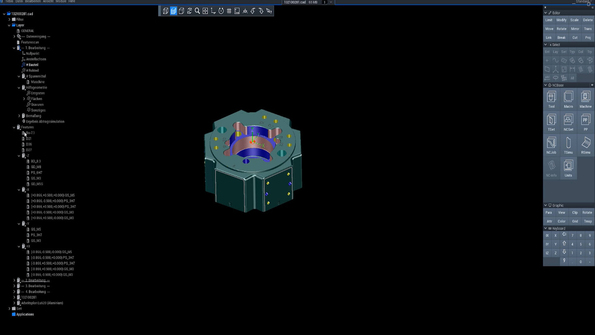 The color coding is already provided by the designer. Tebis recognizes individual features from the CAD and, based on the machining tasks colors, assigns the appropriate tools from the inventory, including the optimal material parameters. – Photo: IPR
IPR products are used all over the world. Customers appreciate that the robotics experts from Kraichgau, Germany offer a broad portfolio of standard components in addition to customized solutions for sophisticated special and large-scale projects. One key success factor is their high level of vertical integration: The development, manufacturing and application departments work together very closely.
“Our product portfolio covers a wide range of standard and special grippers, 7th axes, robot load limiters, axis compensation modules and tool changers for robots,” explains Daniel Schiefer, Deputy Production Manager, CAM programmer and machinist at IPR.Our company stands for robust, reliable and technically high-quality components that significantly simplify and accelerate automation tasks for everyday routines.
Customers from a diverse range of sectors
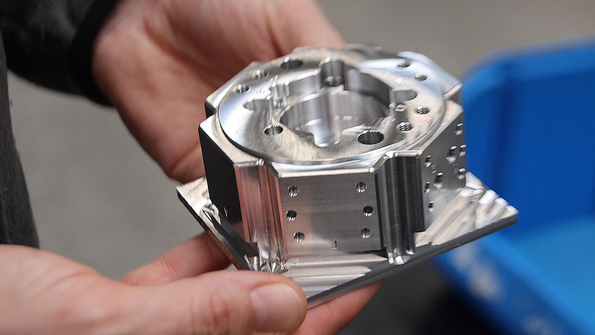 Most workpieces, such as the tool change component shown here, are typical 2.5D parts with tolerances usually in the range of one hundredth of a millimeter. Initially, programming was carried out entirely on the machine. – Photo: IPR
In addition to the automotive industry, customers come from the fields of general mechanical engineering, assembly automation and the supply industry – virtually all areas of production where precise and reliable robotics solutions are in high demand. Customers particularly appreciate the effective combination of a broad portfolio, individual project support and a competent team that supports them from the selection of the right solution through to commissioning.
The individual components are produced in-house with a high level of vertical integration – we have a high-performance production environment consisting of four 5-axis machining centers, several turning centers and, most recently, a turning/milling center with a loading robot. This is because many of our turned parts also require some milling.
Programming was initially done on the machine
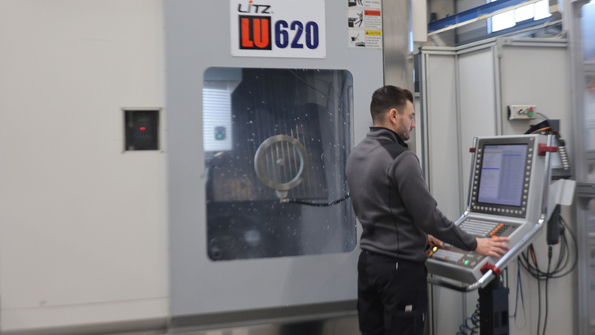 However, the existing machines were not able to operate simultaneously on five axes, so the programming was still manageable. The next machining center to be procured will have this capability while the demand for corresponding parts is growing at IPR as well. – Photo: IPR
To streamline the process chain, machining should be automated as much as possible and take place completely in one setup. This is designed to optimize milling center running times and make best possible use of the available capacities. Machine operators should be effectively supported, especially during the loading and unloading of machines. Two of the 5-axis machines already have robots for workpiece handling, and the turning-milling center has a fully automatic loading cell with robot.
Most of the workpieces are typical 2.5D parts with tolerances generally in the range of one hundredth of a millimeter. Initially, workpieces were programmed entirely on the machine – which was still easily possible with the company’s typical range of parts at the time.
Optimum programming even in 2.5D
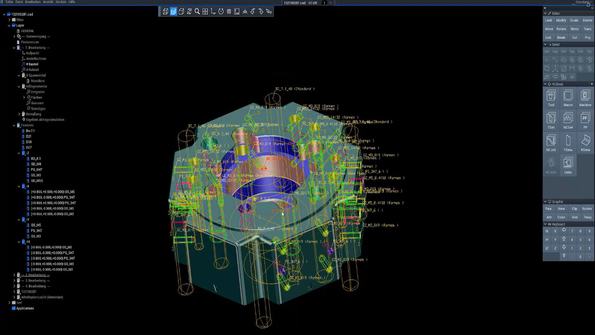 Now, thanks to intelligent feature recognition and automated programming with Tebis, IPR can reduce programming time for parts with numerous holes of varying diameters and angles by around one third. – Photo: IPR
However, it became necessary to machine the nozzle head for a cavity preservation application in the automotive industry. The preservation wax was sprayed into the cavity through numerous holes of varying diameter, which are also arranged at different angles in this workpiece. Manual programming became very cumbersome.
Most parts are programmed with Tebis
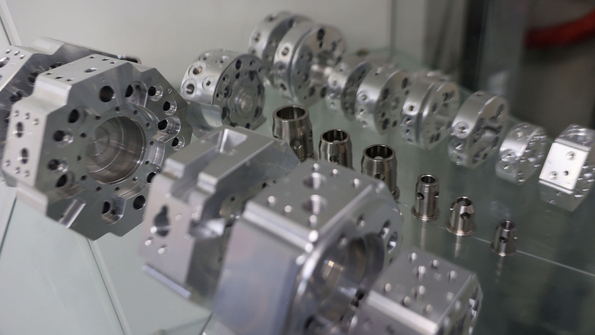 The advantages are convincing: 95 percent of the manufactured parts are now programmed on the CAM system from Tebis, and the proportion of workpieces programmed directly on the machine continues to decrease. – Photo: IPR
That was now more than a decade ago. Today, IPR has several in-house Tebis licenses. “We now create around 99 percent of our 5-axis programs using Tebis and around 80 percent of our 3-axis parts. Only around 5 percent of all parts are now programmed directly on the machine – and even that proportion is decreasing,” explains Schiefer.
With Tebis, we have meanwhile integrated many previously manual processes into machining directly on the machine.
In particular, reworking is minimized as much as possible. For example, many components must be absolutely burr-free. “We used to employ four assistants – a total of two full-time positions – for deburring,” explains Schiefer. “It’s not an attractive job, which is why we set ourselves the goal of ensuring that components were already burr-free when they left the machine. We have largely succeeded in this, with only one of the employees now doing deburring on a part-time basis. And two of the other assistants have completed training as machining mechanics at our company, qualifying them for more interesting jobs with more personal responsibility.”
Automated programming
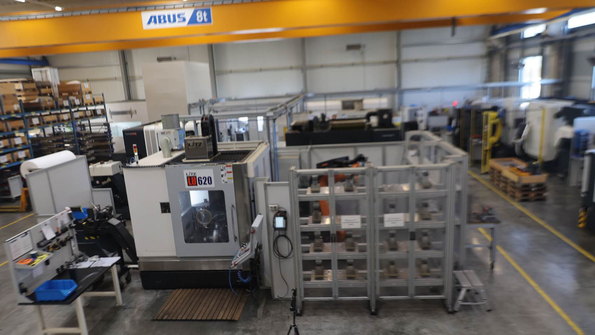 To streamline the process chain, machining should be automated as much as possible and take place completely in one setup. This is designed to optimize milling center running times and make best possible use of the available capacities. – Photo: IPR
However, many things in programming are also much easier now. One very positive effect for Schiefer is the feature recognition in Tebis. “The color coding is already provided by the designer – we currently manage with ten colors,” he says, describing the process. “Tebis recognizes the individual features from the CAD and uses the color for the respective machining operation to assign the appropriate tools from our inventory, including the optimum parameters for the material.
”This is particularly practical when numerous holes have to be created in a component for a tool changer, for example. “In the past, we had to program everything manually, select appropriate tools and assign them, define the cutting values and strategies, and much more,” recalls Schiefer.Today, Tebis does for us this automatically. The programmer only has to take a look at it and perhaps tweak one or two things. If a 10 mm drill bit needs to be used instead of a 12 mm one, for example, the programmer only needs just two mouse clicks.
Programming time reduced by around one third
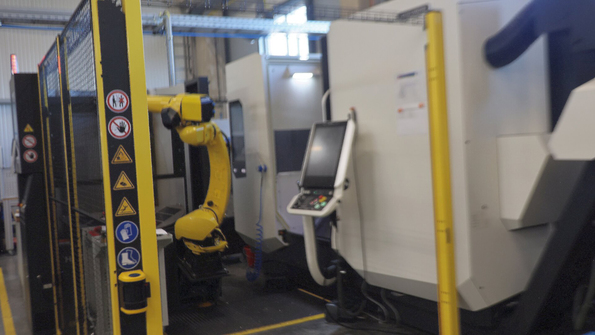 The machine operators should be effectively supported, especially when loading and unloading the machines. Two of the 5-axis machines already have robots for workpiece handling, and the turning-milling center has a fully automatic loading cell with a robot. – Photo: IPR
Above all: “This reduces time-consuming routine work down to a minimum,” he adds. “Now I can concentrate on developing the programs as efficiently as possible, which benefits process reliability and machine runtimes. And Tebis saves time on programming – around one third. This allows projects to be implemented more quickly and machining processes to be carried out in a stable and economic manner – an advantage that is directly reflected in shorter throughput times and higher quality for our customers.”
To ensure that this works reliably, the experts have recorded all cutting tools including their geometrical data, combined this with cutting data for various materials, and stored it all in a database. “We primarily machine high-strength aluminum alloys, with a small proportion of our machining work involving workpieces made of steel, some even of hardened steels. And once in a while, we also machine plastic materials,” adds the machinist.All of this is stored parametrically in the database. In addition to the tools, our machines and clamping devices are also available as digital twins.
Complex collision analysis
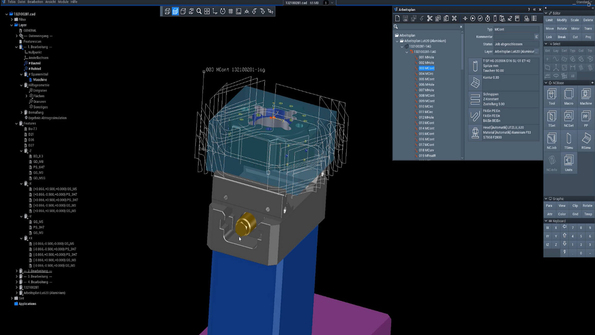 Workpiece clamping is recorded in detail in Tebis. The exact position can also be called up on the machine, allowing the operator to access the current status during setup. The clamping devices are completely recorded in a library. – Photo: IPR
However, this is only based on the manufacturers’ catalog data. “That’s sufficient for the time being – our existing machines can’t work simultaneously on five axes, so the programming is still manageable,” says Schiefer, describing the current situation. “This means that programmers can still reliably perform valid collision control in their heads.”
This will change with the next machine purchase. “The complexity of the parts is increasing, and we now also have a growing need for 5-axis simultaneous machining. In the next few years, we will be acquiring a high-performance machining center that has these capabilities. It will also open up new areas of activity for us,” emphasizes Schiefer.Our current approach will not get us to shift the needle forward – when five axes move simultaneously, the human imagination quickly reaches its limits.
Precise digital twin
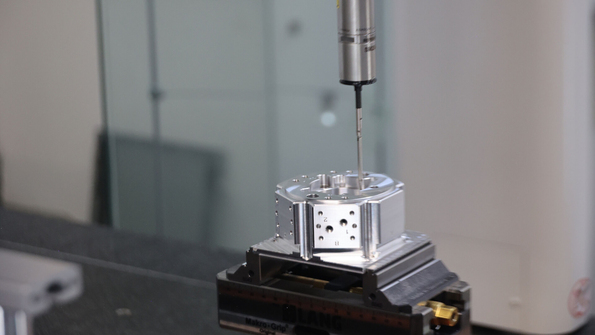 Since temperature changes in the materials can affect machining, the components are also checked in the measuring room to ensure maximum dimensional accuracy. – Photo: IPR
At this point at the latest, a simulation with collision analysis in Tebis makes sense. “However, this can only be as accurate as the data we provide to the software,” says Schiefer. “In order for us to obtain truly reliable results here, it is necessary to precisely measure and record the machine and all relevant production equipment. This gives us a true digital twin that reflects reality one-to-one.”
While milling is currently still being done with Tebis 4.0, those responsible for CAM implementation in the turning and turning-milling area have purchased the current 4.1 version. “The question of whether to purchase a different CAM program for turning did not arise for us,” emphasizes the deputy production manager.Tebis has made great developmental leaps in recent years, especially in turning and turning-milling operation. We feel that we are in very good hands with our software partner. In addition to the software, this is mainly due to the highly competent support we receive. We frequently used this support, especially at the beginning. But even today, we still regularly exchange ideas with the Tebis experts.
Switch to Tebis 4.1
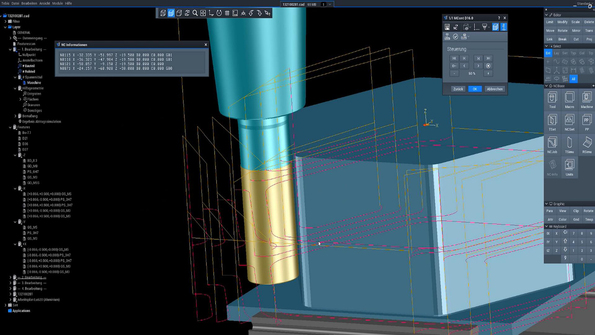 Until now, IPR has been using a digital twin from the manufacturers’ catalog data for simulation. This will no longer be sufficient for valid collision testing in the likes of 5-axis simultaneous machining tasks. Any new machines will therefore have to undergo precise re-measurement. – Photo: IPR
Schiefer sees this as a living partnership. “We feel that we are taken seriously as users,” he explains. When we have challenges to tackle, the experts at Tebis are always very constructive and proactive. And it is clear that they have the ambition to find a truly optimum solution for us fast. This very user-oriented support gives Tebis a unique advantage over all other CAD/CAM providers.”
Programming for the lathes and the turning-milling center also runs very smoothly and quickly in Tebis.Thanks to Tebis training, we are able to use the new functions very effectively,
reports Schiefer. “For us, it is clear that the new version is yet another quantum leap compared to Tebis 4.0. And ultimately that’s one reason why we’ll soon be upgrading the milling area to the new version as well – also in preparation for the move to 5-axis simultaneous milling with the new machine we intend to purchase.”
Optimally equipped for the future
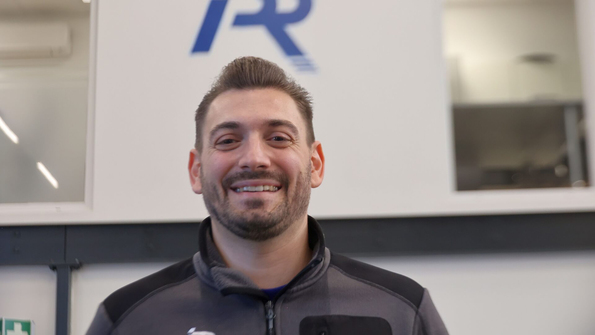 Daniel Schiefer, Deputy Manufacturing Manager, CAM programmer and machinist: “From our perspective, Tebis truly stands out among CAD/CAM providers. And it’s a good feeling for us to know that we already have the right partner in-house for our next development steps.” – Photo: IPR
With Tebis, the experts in robot peripherals know they are perfectly equipped for the future. “Tebis widens the door to significantly more complex machining operations – we will take this into account when purchasing new machines moving forward,” predicts the deputy production manager. “For us, this means that we will not only be able to machine existing parts with greater speed and precision but, in the process, will also develop new skills for entirely novel types of parts.”
This is also necessary given how customer demands are constantly growing and tailored-made solutions are increasingly called for. “We are therefore continuing to evolve dynamically – and we benefit from the knowledge that Tebis provides to us as a reliable partner at our side,” Schiefer concludes.From our perspective, Tebis really stands out among CAD/CAM providers. And it’s a good feeling for us to know that we already have the right in-house partner for the next development stages. Moving forward, this allows IPR to support our customers even more quickly and flexibly with high-performance robotics and automation solutions.
Profile
IPR Intelligente Peripherien für Roboter GmbH
The company develops, produces and sells automation modules for assembly and handling, drive axes for industrial robots and customized solutions across all sectors. The experts in robot peripherals offer ready-to-use standard products while also providing support on special and large-scale projects. Customers reap direct benefits from in-house development and manufacturing technologies. Around 120 international employees fluent in a total of 16 languages work together to implement the projects.Focus
Color coding reduces programmers’ workloads
In CAM programming, color coding is used to automate the machining of specific geometries. The designer can use colors at an early stage to assign standardized machining strategies to features such as holes or pockets. In Tebis, these colors are linked to specific machining strategies such as 2.5D milling or drilling. In the model, the software recognizes the color-coded elements, automatically applies the stored strategy, links it to the appropriate tools and parameters and then uses these to generate the NC program parts for the respective elements. Programmers are significantly relieved of repetitive and routine tasks and thereby gain time for program optimization. The risk of errors is also considerably lowered.Point of view
Genuine partnership is the go-to answer
Good software is one thing – but competent service that helps users tackle challenges and supports them with valuable expertise is just as important, especially for a CAD/CAM provider. The support staff at Tebis earn top marks here – not only from the programmers at IPR – users also praise their high level of technical expertise, the personal commitment of the experts and their openness to finding a viable solution even to very tricky or exotic challenges. Multiple users particularly emphasize this service as the most important unique selling point of the CAD/CAM provider Tebis. For many companies today, it is more important than ever to not only have a good supplier but, in them, a genuine partner they can rely on who will sustainably support their company over its development trajectory.Richard Pergler


